

More than Just a Diagram: Reconstructing the Scientific Foundations of the Medieval Placebo Effect - Tamar Nadav
Updated: Jul 24, 2025
The recent decades have seen a remarkable advancement in the study of the placebo effect. Unlike the study of placebos themselves, which measures the reliability of active medical treatments in comparison to inert treatments, the study of the placebo effect aims to uncover the mechanism that underlies the effectivity of inert treatments drawing on recent advancements in the study of the neurochemical systems, the immune system, and the endocrine system.[1] This conceptual toolkit was, of course, entirely foreign to medieval physicians. For most of this period, physicians considered their main task was to interpret the writings of ancient physicians and adapt them to the dynamic European landscape. It is generally assumed that in doing so, they deepened the hold of ancient misconceptions about human anatomy and physiology rather than engage in personal observation and scientific research.
The following image of the brain, dated to ca. 1200, corroborates this observation in several regards. Found among the illustrations of a pseudo-Galenic text named Historia incisionis, it depicts a cerebral system that can be traced back to Galen and his medieval Arabic interpreters.[2] Rather than providing a realistic representation of the brain and its different parts, it arranges these parts in a diagrammatic structure composed of straight geometrical shapes.[3] The circles in the bottom of the images represent the eyes, linked by the two straight nerves to what appears to be the centre of the nerve system. This is marked by a red stripe in the middle of the image, linked by two straight lines to the upper stripe. The two blue diamonds between them are labelled “the dwelling place of brain [matter] and the locus of reason” (cerebri habitatio et locus rationi), and the four triangles in the upper corners represent the locus of memory (thesaurus cerebri). This diagrammatic structure, highly characteristic of the middle ages, suggests it functioned as a teaching aid for memorization rather than a record of anatomical dissection. Either way, it stresses the rifts that divide medieval and contemporary perceptions of psycho-physiology, presenting the Middle Ages as an era of credulity, nurtured by a stagnant understanding of science as a logical and mathematical expertise.
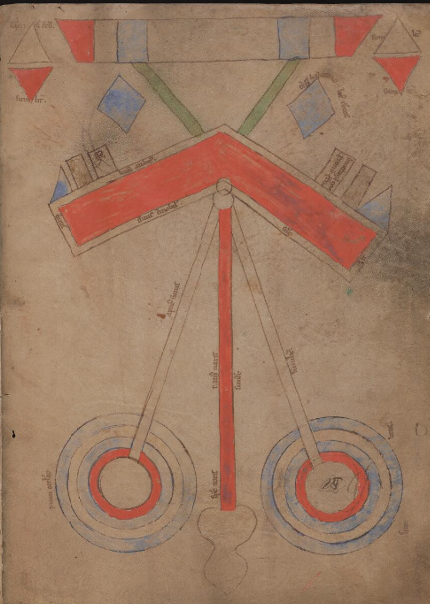
Part of my research at the MedPlacebo Project aims to qualify such comparative observations, as these are often the result of an overly positivist conception of empiricism and technological advancement. A comparison between this image and a modern model of a horizontal cut of the brain offers a particularly visual case in point:

The proportions in the brain on the right emerge as strikingly identical to those captured in brain CT and MRI today. And though the lower part of our medieval diagram seems to have no accurate equivalent in this horizontal cut of the brain, it does seem to correspond to an anterior view of the brain and its ventricle system, as illustrated below. To put it differently, these medieval diagrams of the brain were far less abstract than we tend to consider, and far more rigorous and accurate from a scientific perspective.[4]

Similar rigorousness and attention to detail can be found in contemporary discussions on the brain’s powers (vires, virtutes), written by learned, teaching physicians. There were three powers active in the brain – imagination/sensation, reason, and memory – and each of them was said to act in a different ventricle (cellula) of the brain (cerebrum). Imagination and sensation were placed in the front part of the brain in a ventricle named imaginativa; reason was placed in the middle part of the brain, in the cellula rationalis. Memory was placed in the back part of the brain, in the cellula memorialis.[5]
These teachings circulated in the Arabic world long before they were translated into Latin, at the end of the eleventh century. Their Latin translation, however, resulted in an accelerated process of scientification on the part of Latin physicians, who were interested in consolidating medicine as a theoretical discipline rather than a practical skill.[6]
By the mid-twelfth century, the lessons they gave on these cerebral localizations included a detailed analysis of their material composition and their qualitative characteristics. The imaginative cell, for instance, was more capacious than the other cells and contained more air, because the drying and warming qualities of air were susceptible of capturing the forms conveyed through the optic nerves. By contrast, the rational cell contained a large quantity of brain matter (cerebrum/medulla) because the opposition between the dry air and the moist brain matter facilitated discernment between different forms and qualities perceived through the eyes.[7]
In the following decades, a time of significant flourishing in medical teaching, these ideas fostered a growing attempt to rationalize the mechanism of spontaneous physical responses as a bio-cognitive phenomenon. The famous Bartholomaeus, whose teaching period is dated to the middle of the twelfth century, alluded to this natural mechanism to explain physical responses of anger, joy, and sorrow. According to his explanation, angering or joyful images reached the brain through the optic nerves, where they created a movement in the air that fills the imaginative cell (motus aeris/motio cerebri). This movement dissipated through the arteries to the heart, where it affected the regular flow of blood, heat, and spirit in the blood vessels. These variations, in turn, produced a number of physiological and pathological phenomena, including blushing, panting, popping veins and so forth.[8] In the commentaries of physician Urso of Salerno, written five decades later, this mechanism becomes the key for unravelling the secrets of good health and medical care. Inspired by natural magic as much as Aristotelian physics, Urso used this mechanism to explain an array of psychosomatic phenomena, ranging from the nocebo effect of laxative medicines and imagined poisons, to the disability or impotence caused by demoniac possession or poisonous needles.[9]
Whether this marked development in the Latin medical tradition should be regarded as a turning point in the Western discourse on the body-soul nexus is a story that remains to be told. What is certain is that we should not refrain from telling this story using terms that are being associated today with the empirical study of the placebo effect. Not only because the effect it studies is essentially a universal and timeless phenomenon. But also, because the quest for exploring its underlying mechanisms, both the psychological and the physiological, began long before the scientific revolution or the invention of brain MRI. Likely, it should be sought for in the cross-cultural transmissions that prompted the Twelfth-Century Renaissance and fostered the birth of medieval science.
Footnotes:
[1] See, for example, Fabrizio Benedetti, Placebo Effects, second edition (Oxford, 2014), 125-139; 222-238.
[2] On the history of the text and its accompanying illustrations, known as the five-figure or nine-figure series, see Ynez Violé O’Neill, “The Fünfbilderserie Reconsidered”, Bulletin of the History of Medicine 43 (1969), 236–245; Taylor McCall, “Reliquam dicit pictura: Text and Image in an Illustrated Anatomical Manual (Gonville and Caius College, MS 190/223)”, Transactions of the Cambridge Bibliographical Society 16 (2016), 1–22.
[3] Taylor McCall, “Functional Abstraction in Medieval Anatomical Diagrams”, in Elina Gertsman (ed.), Abstraction in Medieval Art: Beyond the Ornament (Amsterdam, 2021), 289–293.
[4] This is also the conclusion arising in Ynez Violé O’Neill, “Diagrams of the Medieval Brain: A Study in Cerebral Localization”, in Iconography at the Crossroads, ed. Cassidy Brendan (Princeton, 1993), 91-105, though O’Neill approaches it from a different comparative perspective.
[5] Mark Jordan, “The Construction of a Philosophical Medicine: Exegesis and Argument in Salernitan Teaching on the Soul”, Osiris, 2nd series, 6 (1990): 42–61; Irene Caiazzo, “Imagination et intellect chez les maîtres Salernitains”, in Intellect et imagination dans la philosophie médiévale, ed. Maria Cândida da Costa, Reis Monteiro Pacheco, and José Francisco Meirinhos, 3 vols (Turnhout, 2006), 2: 923–39.
[6] Mark Jordan, “Medicine as Science in the Early Commentaries on “Johannitius”’, Traditio 43 (1987): 121–45; Faith Wallis, “The Articella Commentaries of Bartholomaeus of Salerno”, in La Scuola Medica Salernitana: Gli autori e i testi, ed. Danielle Jacquart and Agostino Paravicini Bagliani (Florence, 2007), 125–64.
[7] Bartholomaeus, Glose super Isagogen Iohannitii 12.7, ed. Faith Wallis (Florence, 2022), 257. “Cellula namque rationalis calida est et humida, plurimam partem cerebri cum spiritu animali continens. […] Spiritus namque calide complexionis est et sicce et substantie subtilis. Cerebrum uero humide complexionis est et grosse substantie. Vnde per coniunctionem harum differentiarum coniunctiones rerum et differentias ratio discernit.” See also Oxford, Bodleian library, MS Digby 108, fol. 11v.
[8] Bartholomaeus, In Isag. 11.10, 249. “Omnis itaque affectio a cerebro sumit originem. Verumtamen motu cerebri qui per ymaginationem efficitur per meatus quosdam seu per arterias ad cor redundante, contingit cor amplius dilatari uel contringi iuxta qualitatem rei ymaginate uel sensu percepte. Unde consimilis humor in corde mouetur ; unde gaudium et timor cetereque anime affectiones in corde complentur”. See also Nuremberg, Stadtbibliothek, MS Cent. V 80, f. 16ra. “Aer motus in fantastica cellula per continuationem spiritus descendit ad cor, et ibi inueniens humorem sibi similem cor dilatat. Unde ira uel gaudia, sic de aliis affectionibus animi intelliguntur.”
[9] See Urso of Salerno, Aphorismi cum glossulis 24-25, ed. Creutz, 49-56. See also Maaike van der Lugt, “The Learned Physician as a Charismatic Healer: Urso of Salerno (Flourished End of Twelfth Century) on Incantations in Medicine, Magic, and Religion”, Bulletin of the History of Medicine 87.3 (2013): 307–46.
Further reading:
Adam Cohen, “Diagramming the Diagrammatic: Twelfth-Century Europe”, in Marcia Kupfer, Adam Cohen & J. H. Chajes (eds.), The Visualization of Knowledge in Medieval and Early Modern Europe (Turnhout, 2020), 394‒395.
Danielle Jacquart, “Medical Education in the Twelfth Century”, in Cédric Giraud (ed.), A Companion to Twelfth-Century Schools (Leiden, 2019), 203–225.
Laetitia Loviconi, “Cœur, cerveau et nerfs dans les théories explicatives antiques et médiévales des mouvements volontaires”, La lettre des Neurosciences 63 (2022), 1–6.
Taylor McCall, The Art of Anatomy in Medieval Europe (London, 2023).
Tamar Nadav, “The Mediating Spirit in Salernitan Reflections on the Body-Soul Nexus”, in Laetitia Loviconi & Antoine Pietrobelli (eds.), Corps et âme: Leurs interactions selon les médecins et les philosophes de l'Antiquité à l'époque moderne (Paris, 2025), 113-142.
Faith Wallis, “Twelfth-Century Commentaries on the Tegni: Bartholomaeus of Salerno and Others”, in Nicoletta Palmieri (ed.), Les parcours de l’Ars medica (Tegni) de Galien: lectures et interpétations depuis la fin de l’Antiquité jusqu’aux Universités médiévales (Saint-Étienne, 2008), 127–168.


I enjoyed reading this guide because it focuses on simple roadside preparation. Finding Jump Start Fairfield CT can be useful when battery problems interrupt everyday travel plans.
Packaging can become a daily operational issue for small businesses because every order involves time, storage, and material use. I found custom boxes for small business relevant because smaller companies may benefit from packaging that is designed around their specific products. Standard boxes can sometimes leave too much empty space or require additional filler, which may complicate the packing process. A better-fitting format can potentially make orders easier to prepare and more consistent. I also think small businesses should consider how packaging contributes to their identity, particularly when customers primarily interact with them online. A simple branded box can create continuity without requiring an elaborate design. However, protection should remain the priority because damaged products can create bigger problems later. Businesses…
This article makes it much easier to understand what to expect from a qualified Terre Haute plumber. I appreciate the honest advice and practical recommendations that help readers make informed decisions before hiring local plumbing services.